
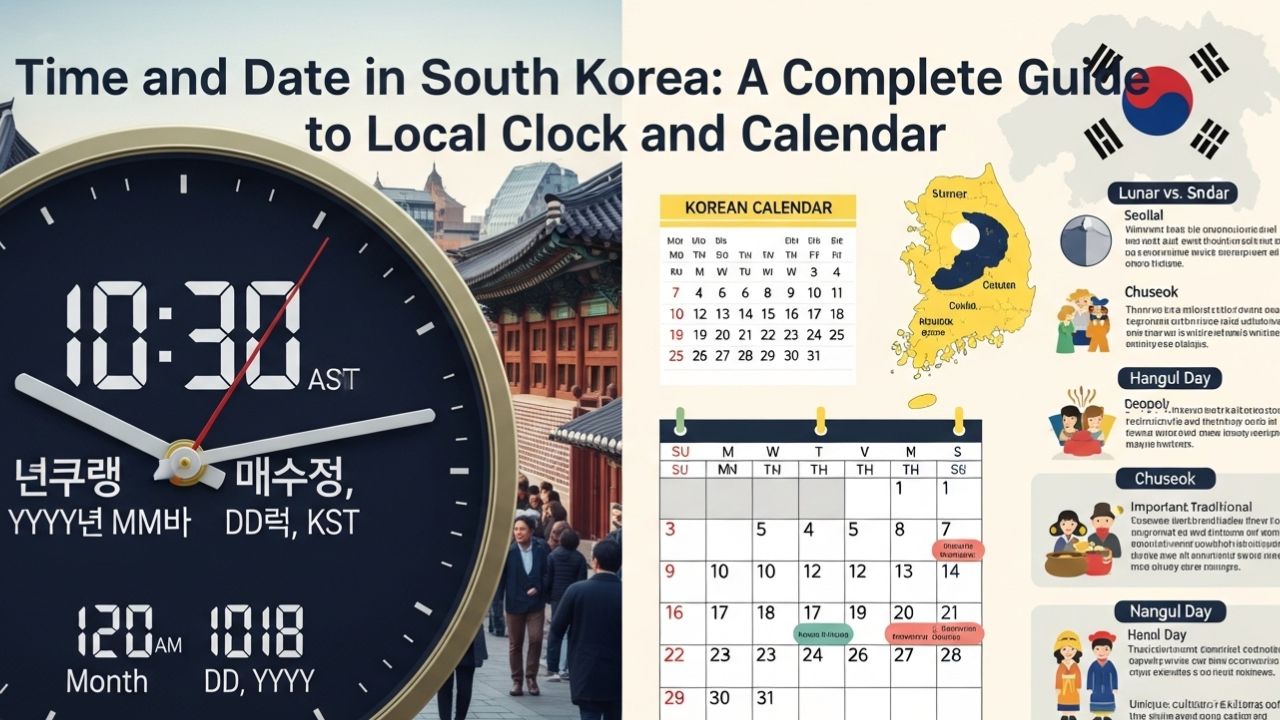
Understanding time and date in South Korea is essential for travelers, international business, remote meetings, and everyday planning across time zones. South Korea follows a single official time standard throughout the country and uses the global Gregorian calendar to organize dates. Whether you’re scheduling a call with someone in Seoul, planning a vacation to Busan, or simply comparing clocks across the world, knowing the time and date in South Korea helps avoid confusion and ensures accurate coordination. This article explains how local time works in South Korea, how dates are written, and how the country’s clock relates to global time standards.
What Is the Time in South Korea
Korea Standard Time (KST)
The official time zone used across the country is Korea Standard Time (KST). This time standard is UTC+9 hours, which means clocks in South Korea run nine hours ahead of Coordinated Universal Time (UTC).
Korea Standard Time is consistently applied throughout the entire country, including major cities like Seoul, Busan, Incheon, Daegu, Gwangju, and Daejeon. All regions observe the same clock, making time and date in South Korea uniform without any regional differences.
No Daylight Saving Time
Unlike many countries, South Korea does not observe daylight saving time (DST). This means the local time does not change for any part of the year — the clocks remain on KST (UTC+9) all 365 days.
Originally, temporary DST changes were tested during events like the 1988 Seoul Olympics, but no permanent seasonal clock shifts remain in effect today.
How the Date Works in South Korea
South Korea uses the widely‑adopted Gregorian calendar, the same system used in most of the world for civil and business purposes. This calendar divides the year into 12 months — January through December — with dates numbered from the 1st to the 31st depending on the month.
Local Date Format
When writing the date in South Korea, the format typically places the year first, followed by month and day. In native usage, the Korean language expresses this with suffixes denoting the year (년), month (월), and day (일). For example, 2026년 4월 4일 translates to “April 4, 2026” in English ordering.
In formal numeric contexts, South Koreans often use the YYYY.MM.DD format — for example, 2026.04.04 — especially in documents, computer systems, and official records.
Time Notation and Formats
South Korea uses both 12‑hour and 24‑hour clock formats depending on context. In informal, everyday conversation, people commonly use the 12‑hour clock with AM/PM markers. However, for schedules such as transportation timetables, TV listings, and official timetables, the 24‑hour format is more standard to avoid confusion.
When writing dates, the national convention often adds unit labels (year, month, day) in Korean. Computer systems and internet platforms also support ISO‑8601 style formats such as “2026‑04‑04 14:30:00” which can be used in global settings.
Why Knowing Time and Date in South Korea Matters
Travel Planning
If you’re visiting South Korea, knowing the time and date helps with adjusting to local time, scheduling flights, and planning daily activities. Because South Korea is UTC+9 hours, the time difference can be significant if you’re traveling from Europe, the Americas, Africa, or the Middle East.
Business and Communication
South Korea is a major economic hub with industries in technology, finance, education, and entertainment. Scheduling meetings with partners in South Korea requires awareness of local time to avoid late‑night or early‑morning calls. The consistency of Korea Standard Time simplifies international collaboration by eliminating seasonal clock changes.
Cultural Events and National Holidays
Knowing the date in South Korea is important for participating in cultural festivals and public holidays. For example, Korean New Year (Seollal) and Chuseok (Harvest Festival) are based on a lunar calendar but lead to specific dates in the Gregorian calendar each year. Clear understanding of the date ensures you join events on the correct day.
Comparing Time to Other Regions
Because South Korea is UTC+9, it is significantly ahead of many global regions:
- Compared to UTC (GMT), South Korea is 9 hours ahead.
- Relative to London (UTC+0), South Korea can be 9 hours ahead.
- Versus New York (UTC‑5/‑4), it could be 13–14 hours ahead depending on seasons elsewhere.
- Compared with Tokyo, Japan, the time is the same, as Japan also uses UTC+9.
Understanding these differences helps with planning live events, coordinating travel, and scheduling international digital interactions.
Common Questions About Time and Date in South Korea
Does South Korea Ever Change Time for Seasons?
No — South Korea stays on Korea Standard Time (UTC+9) all year without seasonal daylight‑saving adjustments.
How Are Dates Spoken in South Korea?
Dates are usually expressed with the year first, followed by month and day. The spoken format mirrors written usage — for example, “2026년 4월 4일” for April 4, 2026.
Can I Use 24‑Hour Time?
Yes — formal schedules, timetables, and official displays frequently use 24‑hour notation to avoid confusion in busy urban contexts.
Conclusion
Understanding time and date in South Korea helps people connect across cultures, travel efficiently, and coordinate activities globally. South Korea uses Korea Standard Time (UTC+9) without daylight saving adjustments, and dates are written in a clear year‑month‑day order. Whether you’re visiting Seoul, making international business plans, or simply curious about global clocks, knowing how time and date work in South Korea ensures you stay organized and in sync with one of Asia’s most vibrant nations.